
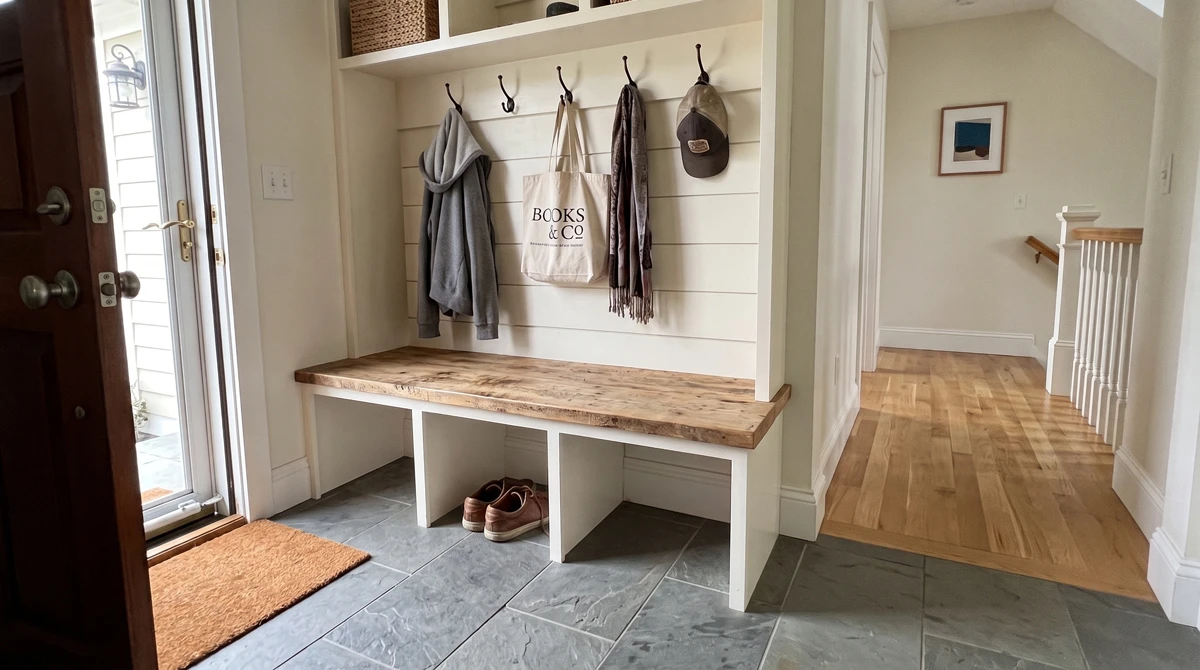
Our mudroom bench sat empty for almost two years. Not because nobody sat there — because nobody wanted to. The plywood top was cold, hard, and had a seam running right down the middle that you could feel through your socks every single morning. My husband must have said “we should really get a cushion for that” a dozen times, and somehow neither of us ever ordered one, because every search turned up the same handful of rectangles: 48 inches, 52 inches, 60 inches. Our bench is 54.5 inches, with two raised hinge lids on either end.
If you’ve got a built-in mudroom bench, you can probably guess what happened next. We ordered one that ran two inches short, so it left a strip of bare wood on one side. We returned it, ordered a longer one, and that one buckled up over the hinges. Eventually the whole thing got shoved into a corner of the garage, and the bench went back to being a place where shoes pile up instead of a place where anyone actually sits.
The bench wasn’t the problem — the shape was
A designer friend put it plainly when I complained to her: mudroom benches almost never come in a standard size, because they’re built around the storage cabinets and wall framing already in the house, not the other way around. A recent roundup of mudroom bench layouts from interior designers makes the same point — most built-ins are shaped around cubbies, drawers, and hooks first, and the seat is whatever space is left over. That’s exactly why a rack-bought cushion almost never lines up.
Our bench had two lift-top storage compartments at each end, and the hinges sit about half an inch proud of the flat center section. Any flat rectangular cushion just balances on top of that ridge, rocks when you sit down, and eventually the foam inside gets crushed unevenly right where the hinge line hits it.

Why standard cushions look cheap on a built-in bench
Once we started looking at custom, I understood why the off-the-shelf option never looked right, even the times it technically fit. A few things give it away immediately:
- Most stock cushions use 1.5 to 2 inches of low-density foam. It flattens within a season and starts looking deflated in photos.
- The fabric is usually a soft cotton-poly blend that wrinkles and sags instead of holding a clean, upholstered line.
- Corners are overlocked or serged rather than boxed, so the edges look floppy instead of tailored.
- Any gap between the cushion and the bench edges reads as a mismatch, even a small one.
None of that is really the cushion’s fault — it’s built for a generic frame, not yours. A properly cut cushion, boxed at the edges and sized to the exact bench, reads more like part of the millwork than something you dropped on top of it.
The measuring mistake we almost made twice
I assumed measuring would be the easy part. It wasn’t. The first set of numbers we sent over was wrong, because I measured the outer edge of the bench top instead of leaving clearance for the storage lids to open and close. The second thing I missed: the surface isn’t perfectly flat. There’s a slight 3-millimeter rise near the wall side from years of humidity in the entryway.
Customer support suggested measuring the compartment both fully open and fully closed, then splitting the difference with a small buffer. That one adjustment is the difference between a cushion that lasts and one that frays at the edge from rubbing against the lid every time someone opens it. If your bench is recessed into cabinetry the same way ours is, it’s worth double-checking those numbers before you submit an order — a redo costs more time than getting it right the first time.

Choosing a fabric for the dirtiest bench in the house
A mudroom bench takes more abuse than almost any other seat in the house — muddy boots, a wet dog, a dropped juice cup, backpack zippers scraping across it every day. We ruled out cotton and linen blends immediately and landed on a solution-dyed performance fabric in a muted sage-grey, mostly because darker, muted tones hide daily grime better than anything pale.
We’d made the opposite call for our living room sofa cushions, which is a good reminder that different rooms really do need different materials — what works in a low-traffic living room won’t hold up at the front door.

The ten-day wait, and what changed after
We’re not going to pretend custom is instant. From the day we submitted final measurements to the day the box showed up, it took ten days — cutting the foam, sewing the cover, and shipping it out. That’s normal for anything made to order rather than pulled off a shelf, and honestly, after two years of an empty bench, ten more days wasn’t the part that bothered us.
What changed once it arrived was small but noticeable. Our kids actually sit down to put shoes on now instead of hopping on one foot by the door. The dog has a spot to wait while we towel off her paws. None of that required a renovation — just a cushion that finally matched the bench it was sitting on.

If you’re weighing whether a custom-fit bench cushion is worth it for a similarly awkward space, the honest answer is: it depends on how much that bench actually gets used. Ours went from ignored to the busiest seat in the house.
Mudroom Bench Cushion Questions, Answered
Why do standard off-the-shelf cushions look so cheap on a mudroom bench?
Three things usually give it away:
- Foam is typically 1.5–2 inches thick and flattens within months under daily use.
- Edges are serged, not boxed, so they look soft and unstructured instead of tailored.
- The size is generic, so gaps or overhangs at the corners are almost unavoidable.
A cushion built to the bench’s exact dimensions, with boxed edges and denser foam, closes all three gaps at once.
What is the standard depth and length of a mudroom bench cushion?
There isn’t one. Off-the-shelf options typically run 36, 43, 48, or 60 inches long and 16–18 inches deep. Built-in mudroom benches rarely match those numbers because they’re framed around cabinetry, not a catalog size. Most real-world benches fall somewhere in between — which is exactly why so many buyers end up with a cushion that’s 1–3 inches too short or too long.
How do you secure a bench cushion so it doesn’t slide when you sit down?
Three anchoring methods work, in order of how secure they are:
- Non-slip rubber backing — good for smooth wood or laminate tops, no hardware needed.
- Corner or edge ties — loop around bench legs or brackets, best for benches with exposed framing.
- Hook-and-loop strips — hold the cushion flat against the surface, best for lift-top storage benches where ties aren’t practical.
For a bench with storage lids, hook-and-loop or a non-slip backing usually works better than ties, since ties can catch on the hinge.
Is it cheaper to DIY or order custom mudroom bench cushions?
DIY is usually cheaper upfront if you already own a sewing machine. Budget roughly:
- High-density foam, cut to size: $30–$70
- Performance fabric, 2–3 yards: $40–$90
- Zipper, batting, thread: $10–$20
That puts a DIY cushion around $80–$180 in materials, before your own time. A custom-ordered cushion in a comparable performance fabric typically runs higher than that, but it comes boxed, zippered, and cut to the exact bench — no sewing errors, no wasted fabric, no second attempt.
What type of fabric is best for a high-traffic entry mudroom cushion?
Solution-dyed acrylic (like Sunbrella) or a polyester performance weave are the two most common choices for entryways. Both resist water, stain, and fading, and both can be spot-cleaned or wiped down. Cotton, linen, and chenille blends are best avoided here — they absorb moisture and show dirt faster than a mudroom can handle.
Why does a mudroom bench feel uncomfortable to sit on without a cushion?
Most mudroom benches are built from plywood, MDF, or painted pine — materials chosen for durability, not comfort. Without padding, there’s no give when you sit, and the surface stays cold in winter and warm-sticky in summer. That’s usually enough to make people stand and change shoes instead of sitting down, which is why so many mudroom benches end up used for storage instead of seating.
How do you measure a recessed mudroom bench for a custom flush-fit cushion?
For a bench boxed in on three sides, follow these steps:
- Measure width and depth at three points — front, middle, back — since recessed openings are rarely perfectly square.
- Use the smallest of the three measurements as your final number, not the largest.
- Subtract 0.25–0.5 inches from each side for clearance, so the cushion doesn’t bind against the walls.
- If the bench has lift-top storage, measure with the lid both open and closed, and split the difference.
Going a half-inch too large is worse than going slightly small — an oversized cushion won’t drop into the recess at all.
What cushion foam thickness gives a mudroom bench a high-end built-in look?
3 inches is the sweet spot for most mudroom benches. Here’s how the range breaks down:
| Thickness | Result |
| 2 inches | Reads thin and flat, especially on a wide bench |
| 3 inches | Full, tailored look without blocking coat hooks or shelving above |
| 4+ inches | Can raise seat height too much and crowd out hooks mounted close to the bench |
Foam density matters as much as thickness — a high-resiliency foam around 1.8–2.5 lb density holds its shape far longer than the low-density fill used in most stock cushions, which is part of why better foam costs more upfront but doesn’t need replacing every year.
Can custom mudroom cushions withstand kids, pets, and wet raincoats daily?
Yes, if the materials are matched to the job. Look for three things before ordering:
- A water-resistant or solution-dyed cover fabric, not just a stain-resistant coating sprayed on top.
- A removable, machine-washable or wipeable zippered cover, so a muddy paw print isn’t permanent.
- Foam that won’t hold moisture — closed-cell or quick-dry foam if the bench sits near an unheated entry.
A cushion missing any one of those three tends to be the one that gets tossed within a year. Recent design coverage on 2025 mudroom trends points to the same shift — more households are treating the mudroom as a real living space rather than a throwaway utility room, which is pushing demand toward materials built to actually last there.
If your bench has a similar mismatch problem — hinge lids, an oddly framed recess, a length that never lines up with what’s in stock — it’s worth measuring it properly once and ordering it right, rather than going through the return cycle we did. We build cushions to the bench’s exact dimensions, foam density included, and most orders ship within about ten days of a confirmed measurement. It’s not instant, but it’s also the last cushion you’ll need to buy for that spot.