
- "Commercial Grade" Is a Number, Not a Marketing Word
- The Fire Code Question Nobody Asks Until an Inspector Does
- Foam Doesn't Behave the Same Way at Home and at Work
- Booths Are Rarely a Standard Size, Which Is Kind of the Problem
- The Math Restaurant Owners Actually Care About
- Cleaning Products Will Wreck a Cushion Faster Than Guests Will
- Patios Change the Whole Equation
- It's Not Just Booths
- What Ordering in Bulk Actually Looks Like
Somewhere around the six-month mark, we started getting the same phone call from restaurant owners. Not resort hotels, not big chains — usually a family-owned diner or a 60-to-90 seat casual spot, the kind of place with a regular Tuesday crowd. The booths looked tired. Not dirty exactly, just… flat. Split seams along the tufting, foam that had gone soft and lumpy, fabric that had pilled and dulled in the spots where people actually sit. One owner outside Columbus told us he’d replaced his booth cushions twice in four years and was starting to wonder if that was just what restaurant seating did.
It isn’t. Or at least, it doesn’t have to be. What was actually happening in most of these cases came down to three things that have nothing to do with bad luck: the fabric wasn’t rated for commercial use, the foam was residential-grade, and nobody had measured the booths correctly in the first place. This is the stuff that doesn’t show up on a spec sheet unless you know to ask for it, and for restaurant owners and designers sourcing seating for a high-traffic dining room, it’s worth understanding before you sign off on an order — custom or otherwise.
“Commercial Grade” Is a Number, Not a Marketing Word
Every fabric supplier will tell you their material is commercial grade. Almost none of them will tell you what that actually means unless you ask directly for the Wyzenbeek rating. The Wyzenbeek test measures abrasion resistance in double rubs — basically, how many times a mechanical arm can drag fabric back and forth before it starts to wear through. The Association for Contract Textiles, which is about as close to a neutral referee as this industry has, puts the floor for low-traffic commercial spaces at 15,000 double rubs, and recommends 30,000 double rubs for high-traffic public spaces like restaurant dining rooms.
A lot of the fabric sold to unsuspecting restaurant buyers sits somewhere in the 10,000 to 15,000 range — perfectly fine for a home sofa that gets used a few hours a day, nowhere near enough for a booth that turns over twenty or thirty times on a Saturday night. Here’s roughly how that breaks down:
| Double Rub Rating | Typical Use | Restaurant Suitability |
|---|---|---|
| Under 10,000 | Decorative, low-use residential | Not recommended |
| 15,000–20,000 | Heavy residential, low-traffic commercial | Fine for a slow lounge corner, risky for a booth |
| 30,000+ | High-traffic hospitality | Where most restaurant seating should sit |
| 60,000–100,000+ | Extra heavy-duty contract | Bar stools, QSR seating, anything touched constantly |
Worth noting: ACT itself cautions against treating these numbers as gospel — their own testing found results can vary significantly between labs on the same fabric, and field failures are more often caused by bad cleaning habits than actual abrasion. So the number matters, but so does asking your fabric supplier what cleaning products the material is actually rated for. We build most of our tufted bench cushions around performance vinyls and solution-dyed acrylics that clear the 30,000+ threshold, partly because tufting concentrates wear at every button point, and a fabric that’s borderline to begin with will show it first at the seams.
The Fire Code Question Nobody Asks Until an Inspector Does
Here’s something that surprises a lot of first-time restaurant buyers: flammability requirements for a booth cushion in a public dining room aren’t automatically the same as what applies to a couch in someone’s house. Residential upholstered furniture sold in the US has to meet California’s TB 117-2013 smolder standard, which was federalized in 2021. Public, commercial, and institutional spaces — hotels, restaurants, waiting rooms — often get evaluated against a different benchmark, NFPA 260, which tests individual components rather than the finished piece. The two standards measure similar things but aren’t interchangeable, and local fire marshals don’t always agree on which one they want to see paperwork for.
What this means practically: ask your cushion manufacturer for compliance documentation before the fabric even gets cut, not after installation when your local inspector is standing in the dining room asking for a certification tag you don’t have. It’s a boring conversation to have upfront and a genuinely bad one to have after forty cushions are already sewn.

Foam Doesn’t Behave the Same Way at Home and at Work
The other quiet failure point is foam density, and this one’s harder to catch because it looks fine on day one. A cushion built with lower-density foam feels great in the showroom and in the first few weeks of service. Then somewhere around month four or five in a restaurant that seats people for 90 minutes at a stretch, three or four turns a day, seven days a week — the foam starts to compress permanently and stops springing back. Guests notice before owners do; the seat just feels a little lower and a little harder than it used to.
For seating that gets this kind of continuous cycling, we generally spec higher-density, higher-ILD foam cores than what goes into a comparable home bench cushion, sometimes with a firmer support layer underneath a softer comfort layer on top. It costs more per cushion. It also means you’re not reordering the same booth run eighteen months later.
Booths Are Rarely a Standard Size, Which Is Kind of the Problem
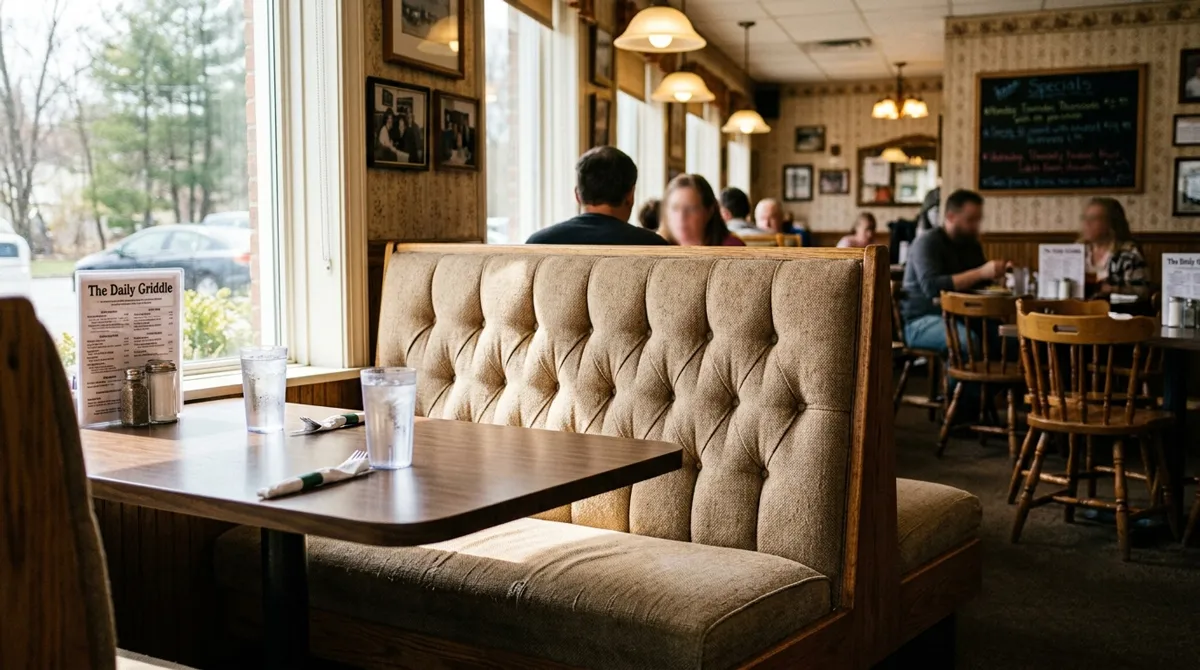
Most restaurant seating gets designed and built into the space — an L-shaped banquette wrapping a corner window, a built-in bench along a load-bearing wall, a run of booths where no two are quite identical because the contractor framed them by eye. Off-the-shelf cushions almost never fit this cleanly, which is how you end up with the gap-and-overhang look that makes even a nice dining room look a little unfinished.
This is really where custom sourcing earns its keep for commercial clients, more than the fabric conversation even. A cushion cut a half-inch short on a 22-foot banquette run isn’t a rounding error, it’s a visible seam of daylight between two seats for the life of the installation. We ask commercial clients to send full measurements booth by booth — not just one number applied across the run — precisely because “close enough” shows up immediately in a space people are staring at while they eat.

The Math Restaurant Owners Actually Care About
None of this matters if the numbers don’t work, so let’s talk about the numbers. A recent industry cost review covering roughly 140 U.S. restaurants found mid-range custom booth seating running somewhere between $1,000 and $1,800 per unit, with casual dining establishments typically budgeting for a 5-to-8-year replacement cycle on their seating. Custom modifications for sizing and branding tend to add another 10 to 20 percent on top of base cushion cost.
That sounds like a lot until you compare it against replacing cheap cushions every 14 to 18 months, which is what tends to happen with sub-15,000-rub fabric and soft foam under real restaurant traffic. Reupholstering a 60-seat dining room twice inside five years, plus the labor and the downtime of pulling booths out of service to redo them, usually costs more than paying for the right materials once. We wrote a longer breakdown of this exact math, custom against off-the-shelf, over on our custom vs. store-bought comparison if you want the full side-by-side.
“We didn’t think about fabric ratings at all the first time around — we picked whatever looked closest to our color scheme. Eighteen months later half the booths had split at the tufting points. The second time, we asked for the double rub numbers before anything else.” — a casual dining client, on redoing their booth seating
Cleaning Products Will Wreck a Cushion Faster Than Guests Will
This one gets overlooked constantly. Restaurants clean aggressively and often, usually with quaternary disinfectants or bleach-based products, and not every fabric that survives a Wyzenbeek test survives a nightly wipe-down with commercial sanitizer. Performance vinyl and coated polyester tend to hold up well here; some natural-fiber blends that look and feel nicer will discolor or crack within months under that chemical load. If your cleaning staff is going to be spraying and wiping these cushions every closing shift, that needs to be part of the fabric conversation, not an afterthought after the first cushion starts peeling.

Patios Change the Whole Equation
It’s the middle of summer as I write this, which means patio season is in full swing, and a lot of the restaurant inquiries we’re getting right now are about outdoor seating specifically. Everything above still applies — plus UV exposure, moisture, and the fact that outdoor cushions get rained on whether the staff remembers to bring them in or not. Quick-dry foam cores and solution-dyed acrylic covers matter a lot more out there than indoors, and we lean on our outdoor bench cushions line specifically because the fill and fabric are built assuming they’ll occasionally get left out in a summer thunderstorm.
It’s Not Just Booths
A good chunk of the same durability math applies to dining chairs too, particularly in smaller family-run spots where the chairs get pulled, dragged across tile, and stacked at closing more than any booth ever will. Chair cushion ties and covers take abuse in ways that seat cushions don’t, since they’re getting handled directly every time someone bumps a chair in or out from the table. Our high-back chair cushions get the same fabric and foam scrutiny as the booth work, mostly because a mismatched or worn-out chair cushion is oddly one of the first things regular guests notice, even if they couldn’t tell you why the dining room looks a little tired.

What Ordering in Bulk Actually Looks Like
Worth being upfront about timing, since this trips people up. For a handful of custom cushions — replacing three or four booth seats, say — we can often turn things around in around 10 days once fabric and dimensions are confirmed. Scale that up to outfitting a 40-to-60 seat dining room and the math changes: cutting fabric in volume, quality-checking every unit against fire code documentation, and coordinating freight for a large order usually pushes that out to three to four weeks. It’s not a dramatic difference, but it’s the kind of thing that should factor into a renovation timeline rather than get discovered the week before a reopening date is already advertised.
We’d rather tell a commercial client that upfront than have them find out the hard way. If you’re sourcing seating for a restaurant, a hotel dining room, or any high-traffic commercial space and want to talk through fabric ratings, fire code documentation, or just get a sizing template started, that’s exactly the kind of conversation our team has every week — reach out and we’ll walk through what your specific space actually needs.