
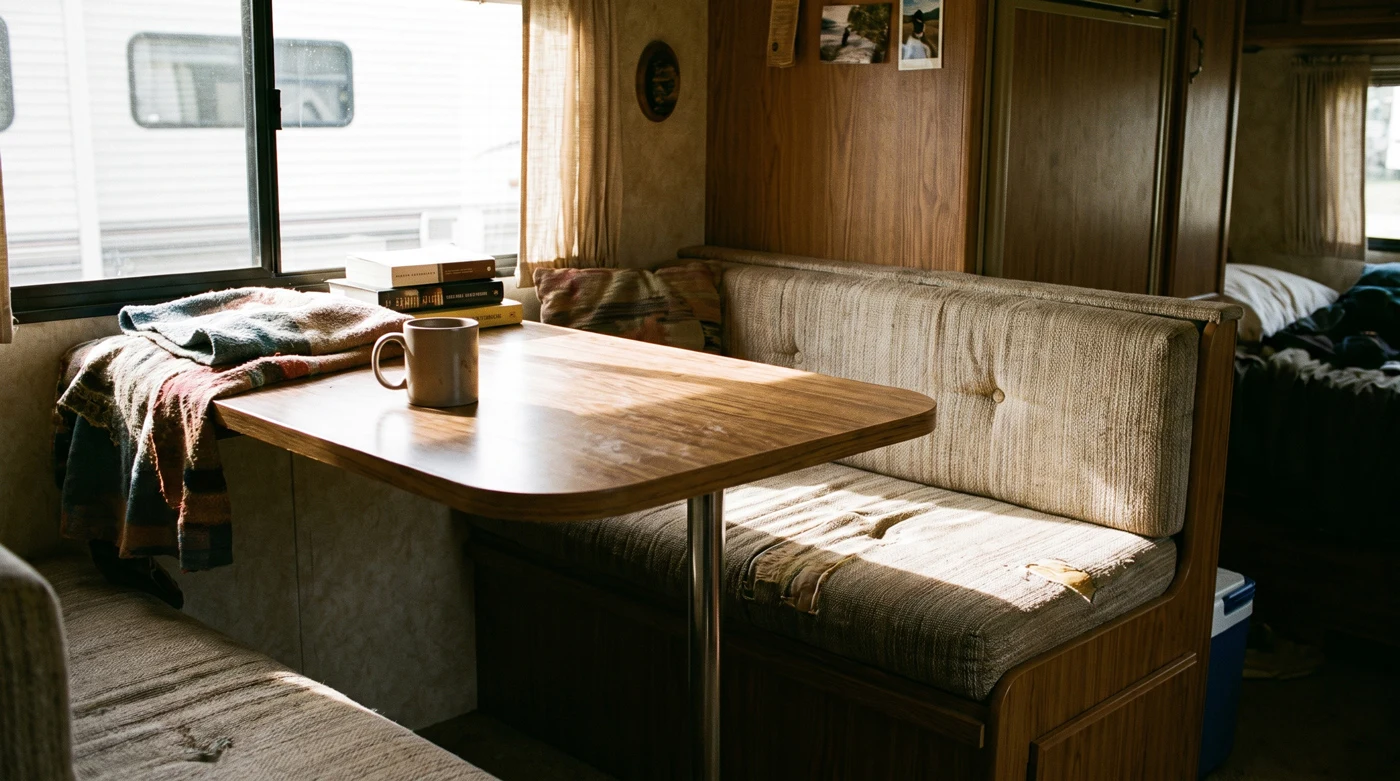
RV dinette cushions take more abuse per year than almost any furniture in a house — constant use, road vibration, and cheap factory foam that gives out fast. This guide covers why standard replacement cushions rarely fit U-shaped booths, what foam and fabric actually hold up, how to measure correctly, and the real cost comparison between your options.
Somewhere around year three or four, almost every RV owner has the same experience: you sit down at the dinette for breakfast and feel the wood platform underneath the cushion. Not a gradual decline — a specific moment where you notice the foam has stopped doing its job. Dinette cushions get more daily use than almost anything else in an RV. They’re where meals happen, where the laptop comes out, where cards get played, and in smaller rigs, where someone sleeps. Factory cushions are rarely built to match that workload.
Why Off-the-Shelf Replacements Rarely Fit
The instinct is to search for a replacement cushion the same way you’d search for a couch cushion — order something close to your old size and swap it in. RV dinette seating makes this harder than it sounds, for a structural reason: very little RV seating is actually rectangular.
U-shaped dinette booths, the most common configuration in travel trailers and many motorhomes, have curved or angled corner sections connecting the straight runs. Those corner radii vary by manufacturer — there’s no shared standard. A straight rectangular cushion dropped into a U-shaped booth either leaves a gap at the curve, overlaps awkwardly, or simply doesn’t sit flush. Booth lengths typically run 48 to 72 inches with seat widths between 18 and 24 inches, but those ranges span a lot of actual variation between brands like Forest River, Winnebago, and Thor — a cushion sized for one manufacturer’s dinette is not guaranteed to fit another’s, even when both are marketed as “standard.”
This is the exact frustration that shows up constantly in RV owner forums: off-the-shelf replacement options from major RV accessory brands turning out too wide, or the wrong shape for a curved corner, leaving owners to either compromise on fit or look at custom and upholstery-shop options instead.

The Real Cost Picture: Three Paths Owners Actually Take
RV forums are full of people comparing notes on what dinette cushion replacement actually cost them, and the numbers vary more than you’d expect depending on the path taken.
Local upholstery shop. Bringing cushions to a shop for new foam and fabric is the most hands-off option — you drop them off, pick the foam density, and the shop handles the rest. Reported costs for a full four-cushion dinette set range widely: some owners report around $300 using basic materials, while others have paid upward of $800 depending on fabric choice and shop labor rates. Availability also depends heavily on location — not every area has a shop set up for this kind of work.
DIY foam and fabric replacement. Many owners order foam directly from suppliers like Foam Factory and replace it themselves, often keeping the existing fabric covers if they’re still in good shape. This route typically runs $150 to $250 in materials for a full dinette set when buying quality foam (2.5–3 lb density) and basic upholstery fabric, plus several hours of cutting and stapling or sewing. It’s the most budget-friendly option for straight-edged booths, though curved corners make DIY foam-cutting considerably more difficult — getting a clean radius cut with a kitchen knife or jigsaw is harder than it looks.
Custom-made cushions. Ordering cushions made to your exact measurements — including curved or angled sections — typically costs more upfront than DIY, often in the range of 40 to 60% above a comparable off-the-shelf cushion, but it solves the fit problem completely rather than approximating it. For U-shaped or curved dinette configurations specifically, this is often the only route that produces a cushion that actually follows the booth’s shape without gaps or overlap.
Upholstery Shop
$300–$800 for a full set. Hands-off, but cost varies widely by shop and fabric. Best when you want zero DIY involvement.
DIY Foam Swap
$150–$250 in materials. Cheapest route for straight-edged booths. Curved corners make this meaningfully harder.
Custom-Made
40–60% above off-the-shelf pricing. The only reliable fix for U-shaped or curved dinette sections.
If the fabric covers are still in decent shape and only the foam has failed, replacing just the foam inside the existing covers is the most economical fix regardless of which broader path you’re considering. The fabric guide covers how to evaluate whether your current covers are worth keeping.
Foam Density: Where Factory RVs Cut Corners
This is the detail that explains why dinette cushions feel fine for the first year and then suddenly don’t. Most factory RV cushions ship with foam around 1 to 1.5 lb/ft³ density — light, cheap, and quick to compress under regular use. Owners who’ve upgraded report the difference is dramatic: moving from factory-grade foam to 3 lb/ft³ high-density foam is consistently described as one of the best value upgrades they’ve made to their RV.
For dinette seating specifically — which needs to support sitting weight for meals and sometimes double as occasional sleeping space — the right range is 1.8 to 2.5 lb/ft³ for the seat base, with a medium-firm ILD (Indentation Load Deflection) rating around 35 to 45. Anything softer bottoms out within months. Anything significantly firmer feels unforgiving for extended sitting. High-resilience polyurethane foam in this density range maintains support and shape far longer than the standard foam most RVs ship with from the factory.

Fabric: What Actually Survives RV Conditions
An RV interior puts more stress on fabric than most home furniture ever experiences. Temperature swings between a hot parked trailer and air conditioning, humidity and condensation, spills, pet hair, kids — all in a space that gets less ventilation than a house. Standard home upholstery fabric struggles with this combination.
Moisture-resistant performance fabric is the practical standard for dinette seating specifically, since it’s the area most exposed to food and drink spills. Marine-grade vinyl is the most durable option for households with kids or pets where wipe-clean performance matters more than soft texture. Performance fabrics like Sunbrella — which carry multi-year warranties against fading and stretching — offer a middle ground: soft enough for comfortable indoor use, durable enough to handle the conditions inside a moving, sitting-in-the-sun vehicle.
One detail worth prioritizing regardless of fabric choice: a removable cover with a real zipper. Being able to take the cover off for washing — rather than spot-cleaning in place — meaningfully extends how long a cushion looks good, and makes it far easier to deal with spills before they set in. For color, deeper tones (emerald, navy, charcoal) tend to hide the inevitable wear and minor staining that high-traffic dinette seating accumulates faster than a lighter palette would. The fabric guide breaks down which fabric types handle which conditions, useful when comparing options for this specific environment.
Measuring a Curved or U-Shaped Dinette Correctly
Generic cushion measuring advice doesn’t account for the corner sections that most RV dinettes actually have. Here’s the process that does:
- Measure each straight section independently. Length and depth for each bench run, treating the booth as multiple connected sections rather than one continuous shape.
- Record the corner radius separately. Where two sections meet at a curve, measure the radius of that curve — most fall between 6 and 8 inches, but yours may not. This number is what makes a cushion actually follow the bench shape instead of leaving a gap.
- Make a template for anything irregular. For curves, angled cuts, or any shape that’s hard to describe in numbers alone, trace the actual seat base onto cardboard or paper. This template is more reliable than measurements for complex geometry and is the single most effective way to avoid a mis-shaped order.
- Measure the platform, not the old cushion. Old foam has compressed and shifted — its current shape reflects years of sitting, not the actual bench dimensions. Pull the old cushion off and measure the wood or platform base underneath directly.
The measuring guide covers template-making and irregular shapes in more depth, including how to translate a cardboard template into order-ready measurements.

Frequently Asked Questions
What are the standard dimensions of an RV dinette cushion?
There isn’t one universal standard. U-shaped dinette booths typically run 48 to 72 inches in total bench length, 18 to 24 inches in seat depth, and 2 to 4 inches in cushion thickness — but these ranges vary by manufacturer and model year. Corner radii on curved sections commonly fall between 6 and 8 inches, also without a fixed standard. Always measure your specific dinette rather than ordering based on a general size category.
How do I measure RV dinette cushions for replacement?
Measure the seat platform directly, not the old cushion. Record length and depth for each straight bench section separately, then measure the radius of any curved corner sections on their own. For complex or irregular shapes, trace a cardboard template against the actual bench surface — this captures curves and angles more accurately than tape-measure numbers alone.
Why are my RV replacement cushions too small after measuring?
The most common cause is measuring the old cushion instead of the platform underneath it. Years of compression shrink and distort foam, so an old cushion’s current dimensions are smaller than the bench it was originally made to cover. A second common cause: not accounting for how much the new foam will compress once wrapped tightly in fabric — a cushion measured with no compression allowance can end up sitting slightly short once finished. Always measure the bare seat base, and build in the compression allowance described below before finalizing an order.
Can you buy pre-made replacement cushions for an RV?
Yes, for standard configurations. Several manufacturers — including RecPro and Thomas Payne — produce pre-made dinette cushions sized to fit common RV brands, and these cover roughly 80% of standard dinette layouts. They’re the most budget-friendly and fastest option when your booth is a typical rectangular or simple U-shape that matches their stock sizes. For curved corners, non-standard depths, or older/discontinued RV models, pre-made options become unreliable fast, and custom sizing is usually the more dependable path.
What is the best foam density for RV dinette cushions?
1.8 to 2.5 lb/ft³ is the right range for dinette seating that needs to handle daily sitting and occasional sleeping use, with a medium-firm ILD rating around 35 to 45. This balances support (so you don’t bottom out within months) against comfort (so it doesn’t feel like a park bench). Factory RV foam is typically 1 to 1.5 lb/ft³ — noticeably below this range, which is the main reason factory cushions feel worn out within a year or two.
How much does it cost to replace RV dinette cushions?
For a full dinette set: local upholstery shops typically charge $300 to $800 depending on fabric and labor; DIY foam-and-fabric replacement runs $150 to $250 in materials; custom-made cushions ordered to exact measurements generally cost 40 to 60% more than a comparable off-the-shelf cushion, but solve the fit problem completely for curved or non-standard booths. Foam-only replacement (keeping existing covers) is the cheapest option across all three paths when covers are still in good condition.
How much overlap or compression allowance should I add to RV cushion measurements?
A standard allowance is to add roughly half an inch to length and width beyond the platform’s bare measurements, and to plan for foam that compresses slightly once wrapped in batting and fabric — meaning the finished cushion sits snug rather than loose against the bench frame. For tight booth spaces where the cushion needs to sit flush against side walls or armrests, err on the tighter side of that half-inch allowance rather than the looser side; a cushion that’s too large for a confined dinette space is harder to fix than one that’s a hair undersized. When ordering custom, specify the bare platform measurements and confirm with the manufacturer how they handle compression allowance — a manufacturer that asks about this detail before cutting foam is a good sign they understand RV-specific fit requirements.
What is the difference between standard furniture foam and marine-grade/RV foam?
Standard home upholstery foam is closed-cell and not engineered for sustained humidity or temperature swings — in an RV environment, it can absorb ambient moisture, develop mildew internally, and break down faster than its rated lifespan would suggest in a climate-controlled house. Marine-grade and RV-specific foam is typically denser, more resistant to moisture absorption, and paired with mildew-resistant fabric facings designed for exactly the humidity and temperature conditions inside a parked or traveling RV. The practical difference shows up after one or two humid seasons: standard foam in an RV is meaningfully more likely to develop an internal moisture problem than foam specified for marine or RV use.
How do I specify asymmetric or angled shapes when ordering custom RV cushions online?
The most reliable method is a physical template, not a written description. Trace the exact seat shape — including curved corners, angled cuts, or any asymmetry — onto cardboard or heavy paper, label key measurements directly on the template, and photograph it from directly above before sending it to the manufacturer. This removes ambiguity that text descriptions (“slightly curved,” “angled about 30 degrees”) can’t fully capture. A custom cushion manufacturer experienced with RV seating should be able to work directly from a template photo plus a few labeled reference measurements, rather than requiring you to describe complex geometry in words alone.
The Bottom Line
The dinette gets used more than almost any other seating in an RV, and it’s frequently outfitted with the cheapest foam the factory could justify. Fixing that — with the right density, the right fabric for the conditions, and a cushion shaped to actually match your booth’s corners — is one of the more straightforward upgrades that makes a real daily difference. The custom cushion range covers the kind of non-standard, curved, and irregular shapes that RV dinettes typically require, and the measuring guide walks through exactly how to translate your booth into an order that fits the first time.