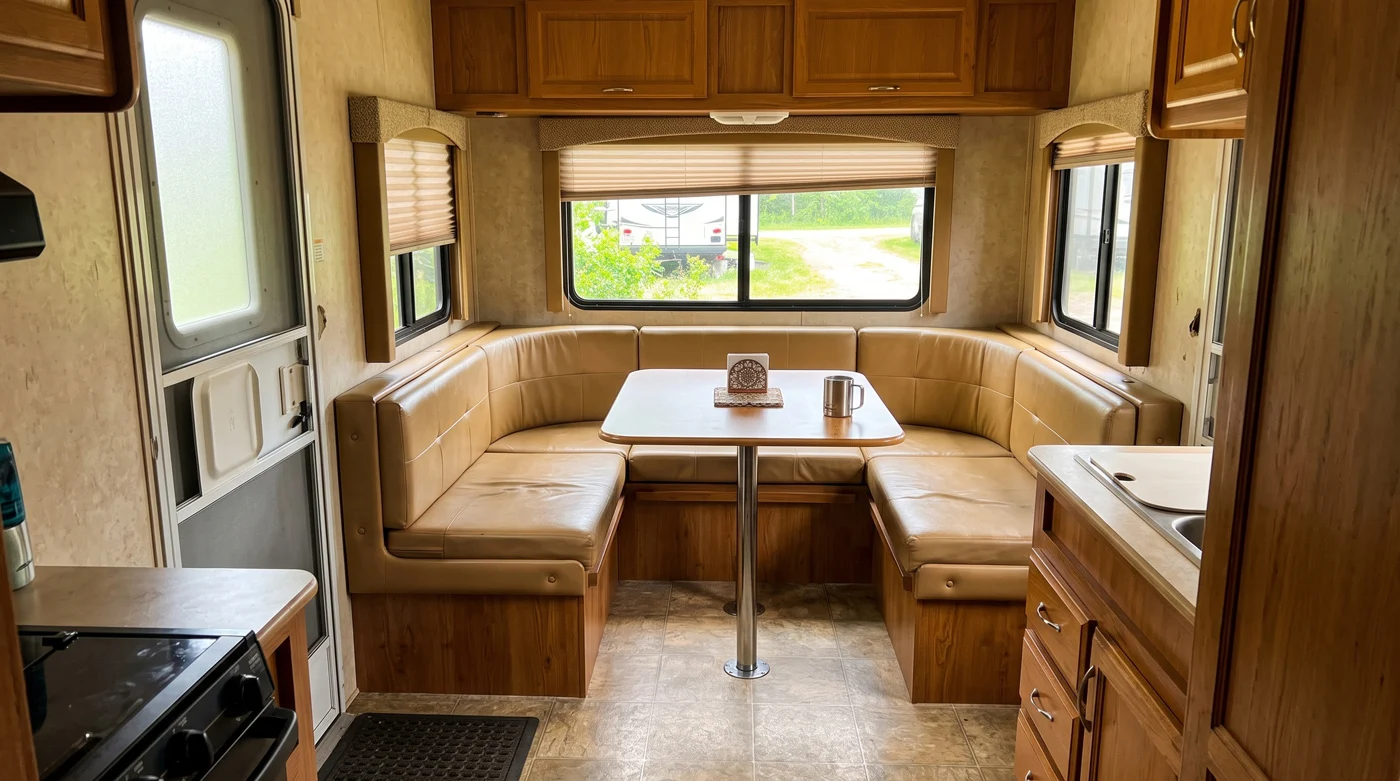
Ask around any RV forum and you’ll find the same complaint repeated in a hundred different threads: the dinette cushions were the first thing to fail. Not the appliances, not the slide-out motor — the seats. Factory vinyl starts showing surface changes within two or three years, and the foam underneath goes flat well before that. We hear from RV owners in exactly this spot every week, and almost all of them are stuck between the same three choices: patch what’s there, replace the covers only, or start over with new foam and fabric.
There isn’t one right answer. It depends on what’s actually failing — the cover, the foam, or both — and what you’re using the dinette for. A couple who only eats meals there has different priorities than a family who folds the table down into a bed every night. This guide walks through the real decision points, then answers the specific questions we get asked most before someone places an order.
Why dinette cushions fail faster than every other seat in the RV
Two things are working against factory dinette cushions from day one. First, the foam. Most factory cushions ship with foam around 1 to 1.5 lb/ft³ density — light, inexpensive, and built to look fine on a showroom floor rather than hold up to daily sitting. Second, the cover material. The majority of RVs use bonded leather or vinyl, both of which rely on a thin polyurethane surface layer bonded to a fabric backing. That surface layer is what eventually fails, not the RV’s actual use of it.

If you want the full breakdown on foam density and how it affects long-term comfort, we cover that in more depth in our guide to replacing RV dinette cushions. This piece focuses more on the decision itself — which upgrade path actually fits your situation.
The three upgrade paths, in plain terms
- Cover-only reupholstery. The foam underneath is still supportive, but the vinyl or fabric is cracking, fading, or peeling. A new zippered cover solves this without touching the foam.
- Full replacement. Both the foam and the cover are failing — cushions bottom out, corners have gone soft, and the fabric is past patching. This is a full foam-plus-cover rebuild, cut to your dinette’s exact dimensions.
- DIY no-sew fix. A short-term or budget-driven option using stretch covers, staple-and-wrap fabric, or hook-and-loop panels — no sewing machine required, though it comes with tradeoffs in fit and durability.
The FAQ below walks through the specific questions that come up for each of these paths — comfort, cost, fabric choice, and the details most people don’t think to ask about until they’re mid-order.
RV Dinette Cushion Upgrade Questions, Answered
How can I make my RV dinette cushions more comfortable for sleeping?
Two changes make the biggest difference:
- Upgrade to foam in the 1.8–2.5 lb/ft³ density range. Factory foam is too soft for sitting and too thin for sleeping — a denser foam supports both.
- Add a Dacron or polyester batting wrap around the foam before it goes into the cover. This softens the seam line where two cushion sections meet to form a bed, which is usually the spot people feel digging into their back.
Matching foam thickness across all cushion sections also matters — mismatched heights are one of the most common complaints once the dinette is folded flat.
Is it cheaper to reupholster or replace RV dinette cushions?
Reupholstering — replacing just the cover — is cheaper if the foam is still supportive. A cover-only order typically runs less than half the cost of a full foam-and-cover rebuild. But there’s a catch: if the foam has already gone flat, a new cover over old foam just hides the problem for a few months before it’s obvious again. The way to check: press down on the cushion. If it bottoms out and you feel the plywood base, the foam needs replacing too — a new cover alone won’t fix that.
What is the easiest no-sew way to recover RV dinette cushions?
Three no-sew methods, ranked by how long they typically hold up:
- Stretch slipcovers — fastest option, pulls on like a fitted sheet, but fit is generic rather than exact.
- Staple-and-wrap fabric — fabric is pulled taut over the foam and stapled to the underside base, giving a tighter fit than a slipcover.
- Hook-and-loop panel covers — pre-cut fabric panels that close with strips instead of a zipper, easiest to remove for cleaning.
All three skip a sewing machine entirely. The tradeoff is fit — none of them match the tailored, boxed-edge look of a cushion cut and sewn to the dinette’s actual dimensions.
Can you use regular foam for RV dinette cushions?
Technically yes, but it won’t last. Standard polyurethane foam sold for general upholstery use is usually rated below 1.5 lb/ft³ — close to what’s already failing in your RV. It compresses quickly under daily sitting and doesn’t handle the humidity swings inside a closed-up RV as well as higher-density options. High-density foam in the 1.8 lb/ft³ range or above is the minimum most upholstery shops recommend for dinette seating specifically, since it needs to support sitting weight for meals and, in many cases, double as a sleeping surface.
Why do RV dinette cushion covers peel or flake so fast?
Most factory RV seating uses bonded leather or vinyl — a synthetic polyurethane surface layer bonded to a fabric backing, not a single solid material. That surface layer is inherently less durable than woven fabric, and UV exposure and heat are the two biggest factors that break it down — both of which are hard to avoid inside an RV that spends hours parked in direct sun. Once the surface layer starts to crack, there’s no real fix; it only gets worse. Performance fabrics and marine-grade vinyl avoid this failure mode entirely because they don’t rely on a bonded surface coating.
How thick should RV dinette cushions be?
3 to 4 inches is the practical range for most dinettes. Here’s the tradeoff:
| Thickness | Tradeoff |
| 3 inches | Matches most factory legroom clearance, moderate comfort gain |
| 4 inches | Noticeably more support, can reduce legroom under the table by about an inch |
| 5+ inches | Best for dinette-to-bed conversions, but may sit higher than the table surface once folded flat |
If your dinette regularly converts to a bed, thickness needs to be checked against the table height too — a cushion that’s too thick will sit proud of the table once the sections are folded together.
Should I choose Dacron/polyester wrap for my custom RV dinette cushions?
In most cases, yes. A Dacron or polyester batting wrap sits between the foam and the outer fabric cover, and it does three specific things:
- Rounds out sharp foam edges so the cushion looks upholstered rather than boxy.
- Reduces wrinkling in the outer fabric, since the batting fills small gaps between the foam and the cover.
- Makes it easier to fit foam into a zippered cover — bare foam edges can catch and tear fabric during installation, batting reduces that friction.
It’s a low-cost add-on relative to the difference it makes in the finished look, which is why most upholstery shops include it as a default rather than an optional upsell.
How do I choose between a zipper enclosure and an elastic bottom for RV replacement covers?
It comes down to how often you’ll be removing the cover to clean it:
- Zipper enclosure — gives a tailored, flush fit with no loose fabric at the corners. Best if the cushion won’t be washed often. Zippers can wear out faster with frequent removal.
- Elastic bottom — pulls on and off like a fitted sheet, ideal for cushions that need frequent washing due to spills, pets, or kids. The tradeoff is a slightly looser fit at the corners over time.
For a dinette that doubles as a kids’ eating spot or sees regular spills, elastic is usually the more practical choice. For a dinette used mainly for adults and occasional meals, a zipper gives a cleaner, more built-in look.
How do stain-resistant performance fabrics hold up against RV condensation and mildew?
Well, if the fabric is genuinely rated for it — not just marketed as “stain-resistant.” Look for two specific things before ordering:
- Mildew resistance built into the fiber itself, not just a surface spray that wears off after cleaning.
- A water-repellent backing, so spilled liquid beads on the surface instead of soaking through to the foam, where moisture actually causes mildew to develop.
Solution-dyed acrylic and treated polyester performance fabrics are the two most common choices that meet both criteria, and neither relies on a bonded surface layer — which is also why they don’t peel the way vinyl and bonded leather do.

Whichever path fits — a new cover, a full rebuild, or foam and fabric cut to your exact dinette dimensions — we build custom RV dinette cushions to the booth’s real measurements rather than a generic size. If you’re only dealing with a peeling cover and the foam underneath is still solid, our replacement cushion covers are the more budget-friendly route, and for anyone weighing DIY against custom, our piece on finding RV dinette covers without the sizing headaches goes deeper into where DIY tends to fall short. Most custom orders ship within about ten days of confirmed measurements — not instant, but a lot faster than most people expect for something built to your exact booth.