
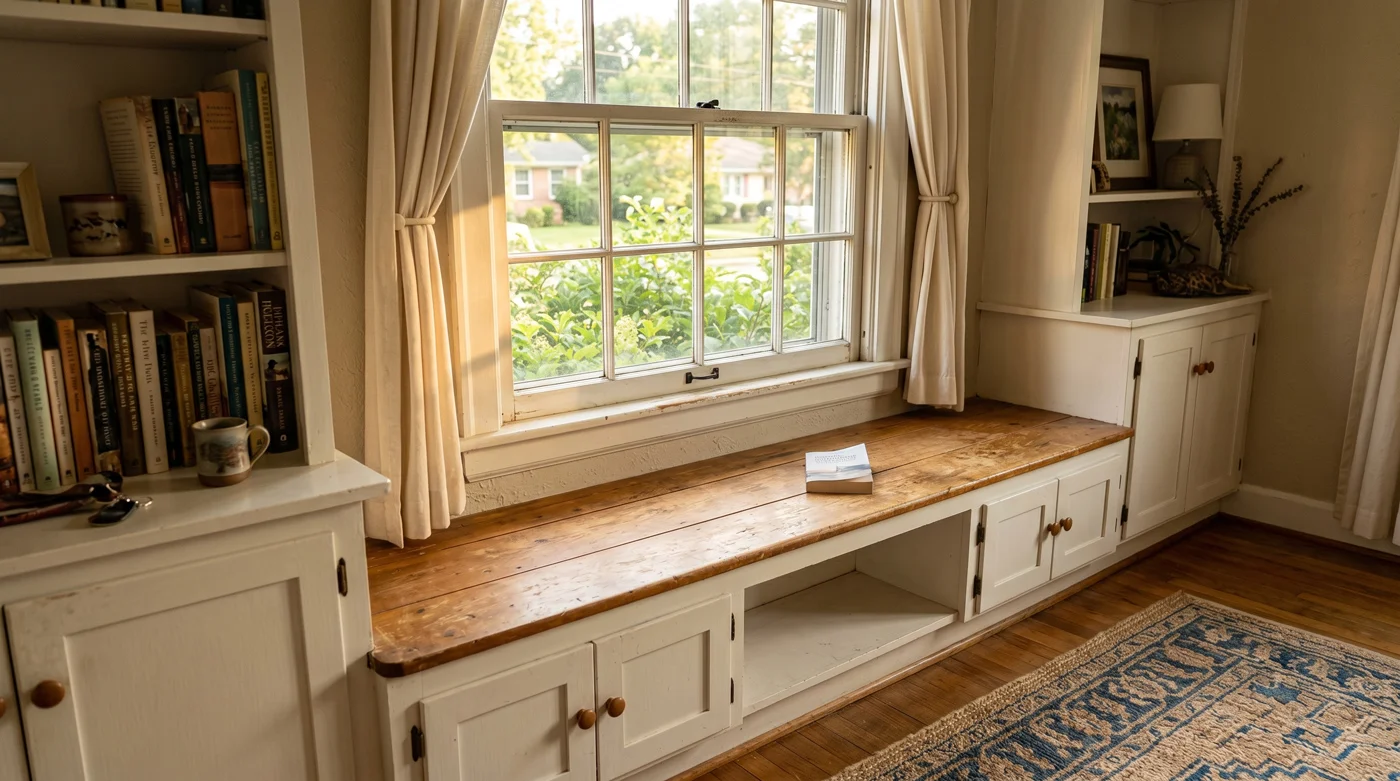
Window seats are one of the most consistently under-cushioned surfaces in the American home — and one of the hardest to shop for correctly. This guide covers the difference between standard and bay window seats, why retail sizing almost never matches real-world dimensions, how to measure for each, and where to find cushions that actually fit.
The window seat has been there the whole time. You walk past it every day, you’ve told yourself you’ll deal with the cushion situation eventually, and somehow it stays exactly as it is — bare wood, or a cushion that’s been quietly flattening for three years, or a throw pillow that technically fills the space but fools nobody about being a real cushion.
When you finally go looking, the shopping experience is more confusing than it should be. Here’s why, and how to find your way through it.
First: Standard Window Seat or Bay Window Seat?
These are two different things, and most cushion listings treat them interchangeably in ways that lead to wrong purchases. Understanding which one you have is the first step.
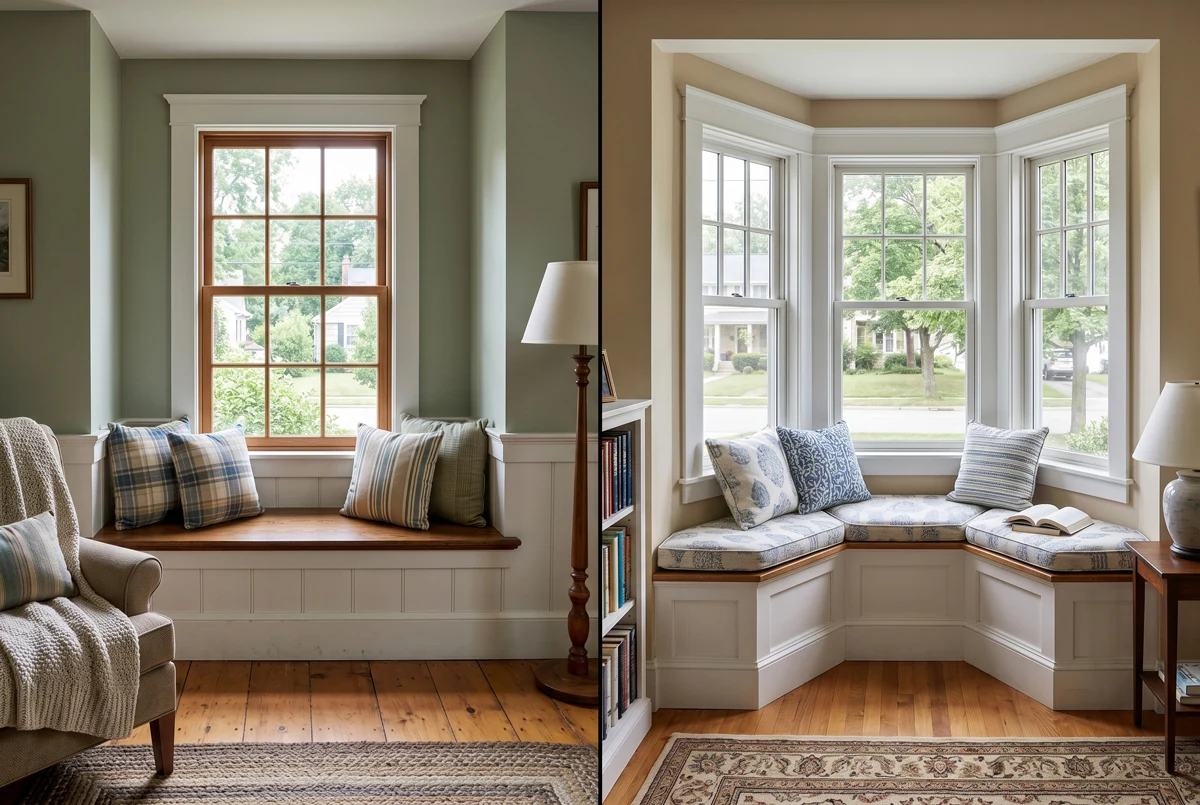
A standard window seat is a straight, rectangular built-in bench that runs along a flat wall beneath a single window or a row of windows. The seat surface is a simple rectangle — length, width, done. This is the easier type to cushion because the shape is straightforward, and the main challenge is finding the right length and depth. Built-ins vary considerably in depth (typically 14 to 22 inches front-to-back), and many have clearance limitations on thickness due to window sill height.
A bay window seat is set into a bay window — a projecting window structure that creates an alcove with angled sides. The seat wraps around the angled interior, which means you’re typically dealing with a central cushion flanked by two angled side cushions, or a single cushion cut to match the trapezoid or pentagon shape of the full bay floor. This is fundamentally more complex than a standard window seat, and shopping for it as if it were a regular bench cushion is where most people run into trouble.
The distinction matters because the buying channels, sizing considerations, and measurement process are significantly different for each. Retail stores almost exclusively stock rectangular cushions for standard window seats. Bay window cushions — done properly — almost always require custom work.
Why Retail Almost Never Fits
Walk into any home goods store or browse any major retailer and you’ll find window seat cushions grouped by a handful of standard lengths: typically 36, 48, and 60 inches, in depths from 14 to 20 inches. These are the sizes that major retailers stock, and the range stops there. If your window seat falls neatly into one of those combinations, retail is worth checking.
In practice, built-in window seats are sized to the architecture of the house, not to a cushion catalog. A window seat built as part of a 1960s ranch renovation might be 52 inches long. A craftsman bungalow window nook might be 19 inches deep. A new construction bench might be 43 inches long with a 17-inch depth. None of these fall neatly into standard retail offerings, and the gap between “close enough” and “actually fits” is exactly what you see every time you look at the window seat after buying the wrong size — a strip of bare wood at one end, or a cushion that overhangs the frame and catches every passerby.
Thickness is the other variable retailers underserve. Window seats often have limited clearance between the seat surface and the bottom of the window sill — sometimes as little as 2 to 3 inches — which means cushion thickness is a real constraint, not just a comfort preference. Retail cushions typically come in fixed thicknesses (usually 3 or 4 inches) with no option to specify otherwise. If your clearance is 2.5 inches, a 3-inch cushion won’t fit under the sill without forcing, and a 2-inch retail option may not exist at all.
Where to Buy: The Real Options
Mass-market retailers. Wayfair, Amazon, Target, and similar stores are worth a look if your window seat is a standard rectangular shape and your dimensions happen to match their offerings. Filter by length first, then check depth. Read the reviews specifically for comments about actual dimensions versus listed dimensions — inconsistencies are common enough to be worth verifying. For anyone with non-standard dimensions, time spent here is mostly time spent being disappointed.
Specialty cushion retailers. Cushion Source, Cushion Pros, and similar dedicated cushion companies offer more size options than mass-market retailers and sometimes allow custom dimensions. Quality is generally better than big-box options, and fabric selection is broader. These are a good middle ground for standard window seats where dimensions are somewhat flexible. For bay windows, most still require you to order individual rectangular pieces and figure out the geometry yourself.
Local upholstery shops. The underused option that offers something no online channel can: someone who can look at your window seat directly. For unusual shapes, tight clearances, or bay window configurations that need to be templated rather than measured, a local upholsterer is often the most reliable path. The tradeoff is that not every area has a well-equipped shop, and pricing varies widely.
Custom online manufacturers. For window seats with non-standard dimensions — which is most of them — and for any bay window application, custom manufacturing is the option that actually solves the problem rather than approximating it. You provide exact measurements, choose fabric and thickness, and receive a cushion made for your specific seat. Rofielty customers have used custom window seat cushions for everything from traditional reading nooks to attic space conversions — situations where standard sizing would never have worked. The custom window seat cushion page handles standard rectangular seats with full dimension input; the custom bay window cushion page covers angled and multi-panel bay configurations.
Etsy makers. A meaningful number of independent upholsterers on Etsy make custom window seat cushions to provided measurements, sometimes in fabrics and finishes that larger manufacturers don’t offer (linen, velvet, piped edges). Quality and lead times vary by seller; read recent reviews carefully and confirm production timelines before ordering, particularly for any time-sensitive project.
Which channel for which situation
Standard rectangular seat, 36/48/60″ length, 14–20″ depth: Start with mass-market retail; specialty cushion sites if retail doesn’t have the right fabric.
Standard seat, odd dimensions or tight clearance: Skip retail and go straight to custom online.
Bay window with angled sides: Custom online manufacturer or local upholsterer with template. Retail is not a realistic option here.
How to Measure a Window Seat Correctly
The measurement process has a few window-seat-specific considerations that generic cushion guides skip over.
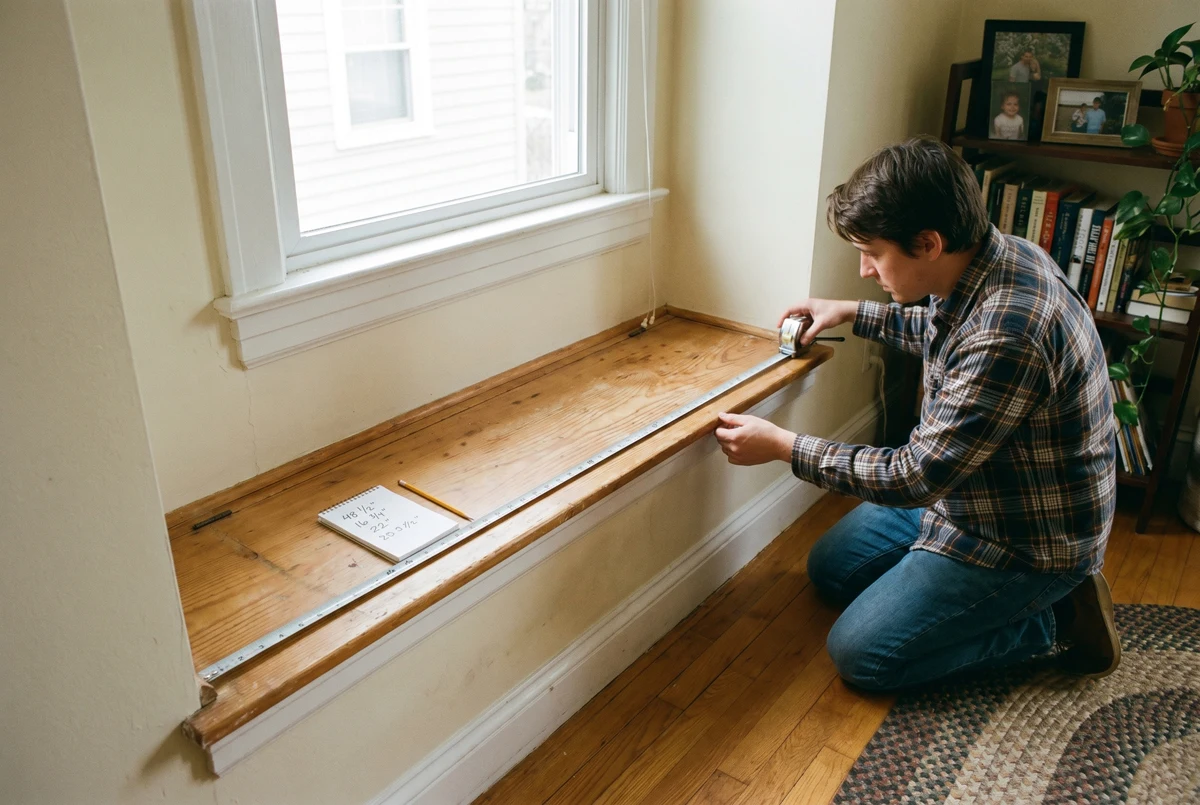
For a standard window seat: Measure the seat surface length from the inner left edge to the inner right edge — not the outer frame, and not any existing cushion. Measure depth from the front edge of the seat to the back wall or back frame. Measure at three points along the depth (left, center, right) because built-in window seats are sometimes slightly uneven; use the smallest measurement. For thickness, measure the clearance between the seat surface and the bottom of the window sill and subtract half an inch for comfortable clearance — this is your maximum thickness, and your cushion should not exceed it.
For a bay window seat: The approach depends on the configuration. If the bay has a flat central seat flanked by two angled side seats, each section needs to be measured separately — length, depth, and the angle where adjoining sections meet. For truly non-rectangular shapes, a paper or cardboard template of the exact seat floor is more reliable than measurements alone. Tape together sheets of paper or cardboard to cover the full seat area, trace the outline, cut it out, and verify it fits the seat before using it as your order template. This adds twenty minutes to the process and eliminates the most common source of error in bay window cushion orders.
The measuring guide covers window seat measurement in detail, including how to handle angled corners, the clearance calculation, and what to do when depth varies across the length of the seat.
Fabric for Window Seats: The Sun Problem
Window seats sit in the sunniest spot in the room by definition. This is part of the appeal — the light, the warmth, the view. It also means the cushion is subject to more direct UV exposure than almost any other indoor surface in the house. A fabric that performs perfectly in the middle of a room will fade noticeably on a window seat within a year or two, particularly on south- and west-facing windows where afternoon sun is most intense.
For window seats with significant sun exposure, the relevant fabric property is whether the color is solution-dyed (embedded in the fiber during manufacturing) or surface-dyed (applied after the fact). Solution-dyed fabrics hold their color through years of UV exposure; surface-dyed fabrics begin fading at the surface level within a relatively short time. This isn’t always disclosed clearly in retail listings — “fade-resistant” is a marketing claim that can mean solution-dyed, or can mean surface-treated, or can mean nothing measurable at all.
For north-facing windows with minimal direct sun, fabric choice can prioritize feel and appearance over UV performance. For any south or west-facing window seat that gets afternoon light, treating it like a mildly outdoor surface and choosing accordingly pays off in visible ways over the first few years. The fabric guide explains what these distinctions actually mean in practice, including which options make sense for different sun exposure levels.

Bay Windows Specifically: What Nobody Tells You
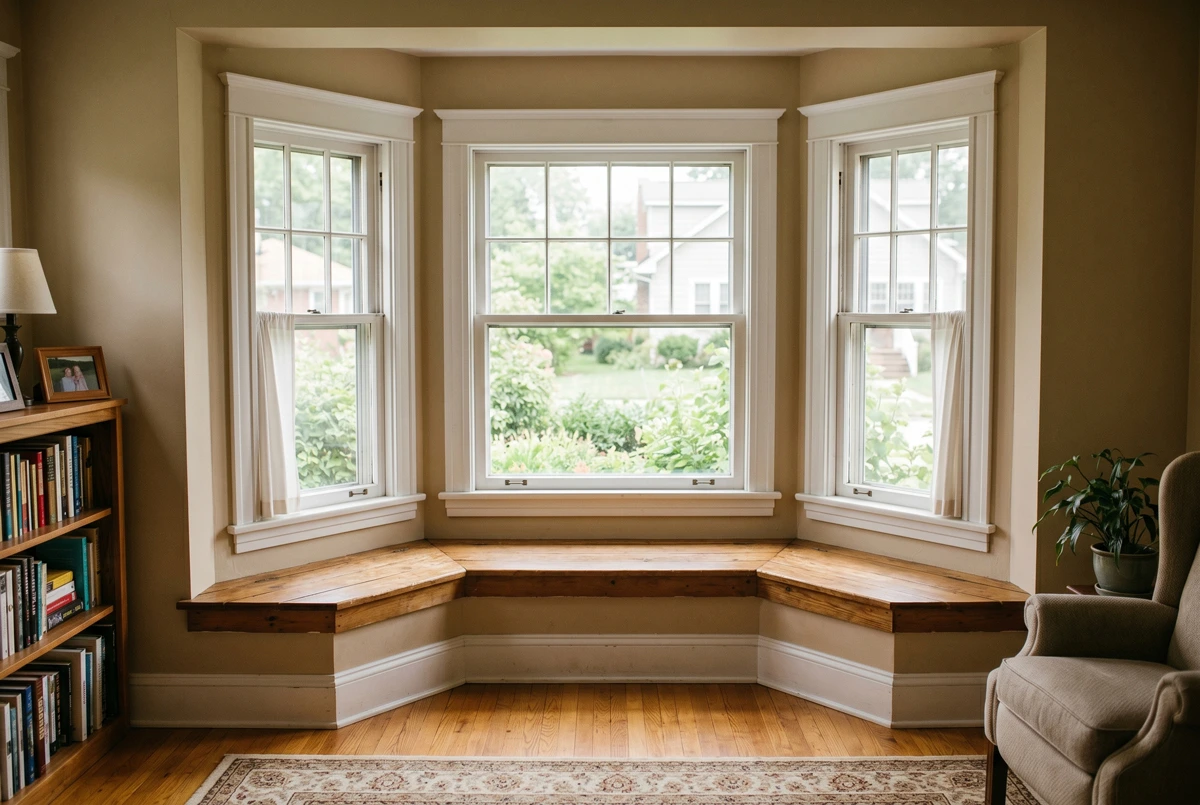
Bay window seats come with an additional complication that standard window seat advice doesn’t address: the angled side panels. A bay window typically has a central flat panel flanked by two side panels set at 30 or 45 degrees. If you want cushioning on those side panels — and most people do, because they’re part of the seating area — you’re dealing with cushions that are trapezoid-shaped rather than rectangular.
Retail stores don’t stock trapezoid cushions. They stock rectangles, which some people prop into the angled sections at an angle or trim themselves. The result is always visible and never quite right. A custom bay window cushion, cut to the exact angles and dimensions of each section, is what makes a bay window seat look finished rather than improvised. The custom bay window cushion page is the right starting point if you’re dealing with angled sections — it handles the geometry that rectangular retail cushions simply can’t.
There’s also the question of whether to cushion the bay as a single unified piece or as separate sections. Single-piece cushions that wrap the full bay floor look cleaner and are easier to sit on as a continuous surface; separate sections per panel are easier to order and replace individually. Both approaches work — the choice depends largely on how you use the space and whether the bay is primarily decorative or genuinely used for sitting.
The Payoff
A window seat is already one of the better features a room can have — the light, the perch, the invitation to sit somewhere slightly apart from the main furniture arrangement. A cushion that actually fits it, in a fabric that handles the sun exposure, is what converts it from an architectural detail to a place people actually use.
The measurement step is the whole key. Five minutes with a tape measure and the measuring guide gives you the numbers you need to order confidently — whether that’s a standard rectangular seat cushion or a full custom bay window configuration. After that, it’s just a matter of choosing fabric and placing the order.